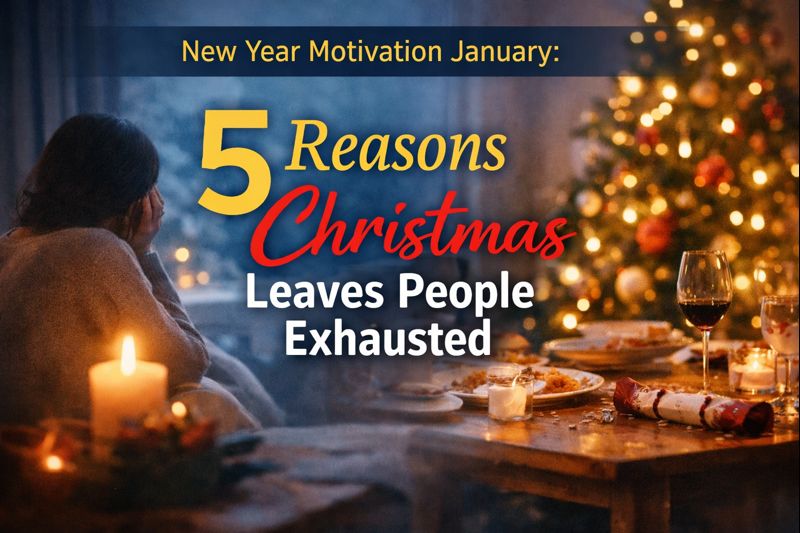
(And it’s not the food, the alcohol, or a lack of gratitude)
New Year motivation January often fades quickly — not because people fail, but because real life, emotional overload, and unrealistic expectations collide.
For something that’s meant to be joyful, Christmas leaves a surprising number of people feeling drained, flat, and quietly relieved when it’s over.
Not hungover.
Not ungrateful.
Just… exhausted.
And yet, this part rarely gets talked about.
Instead, we’re shown a very specific version of Christmas.
Happy families.
Children playing around the tree.
Presents being opened.
Extended families gathered around a table, eating together.
It’s everywhere — adverts, films, social media.
But that picture doesn’t reflect reality for a significant number of people.
According to recent data from the Office for National Statistics, around 8.4 million people now live alone in the UK, accounting for nearly 30% of all households. This number has grown steadily, driven largely by older adults living solo, alongside rising divorce and separation.
For many, Christmas isn’t loud or crowded.
It’s quiet.
Sometimes painfully so.
And whether Christmas is emotionally intense because there are too many people — or emotionally heavy because there are very few — the nervous system still carries the load.
Christmas Isn’t a Break — It’s an Endurance Event
For those surrounded by others, Christmas can mean days — sometimes weeks — of:
- Constant social interaction with little downtime
- Navigating old family roles and unspoken dynamics
- Managing expectations — yours and everyone else’s
- Performing “festive happiness” even when energy is already low
For those on their own, it can mean:
- Long stretches of silence
- Heightened awareness of absence or change
- Comparing reality to the images being shown
- Carrying everything internally, with no outlet
Different experiences.
Same outcome.
In my work with professionals, leaders, and teams, this pattern shows up every year — not as a lack of resilience, but as accumulated emotional load.
New Year Motivation January: Emotional Overload Is the Real Culprit
What most people experience after Christmas isn’t laziness or a motivation problem.
It’s emotional overload.
Too much:
- Noise, conversation, history, expectation
Or for others:
- Too much quiet, reflection, comparison, and internal processing
And too little:
- Regulation
- Decompression
- Space to reset
Your nervous system doesn’t get a chance to stand down.
So when Christmas ends, your body doesn’t feel refreshed — it feels spent.
That’s why people often feel:
- Snappy
- Tired but unable to relax
- Emotionally flat
- Strangely low once it’s “over”
This isn’t weakness.
It’s biology meeting context.
For many people, New Year motivation January doesn’t disappear — it gets buried under exhaustion, social pressure, and the need to keep going.
Why Rest Doesn’t Always Feel Restful
This is the confusing part for many people.
You may have had time off work.
You may have slept later.
You may have slowed your pace.
So why don’t you feel better?
Because rest and regulation aren’t the same thing.
You can stop working and still be overstimulated.
You can sit in silence and still feel unsettled.
You can “relax” while your nervous system remains on alert.
Christmas often removes work stress — but replaces it with relational, emotional, or existential stress.
Different inputs.
Same physiological cost.
Research consistently shows that prolonged emotional and social demand — even when experiences are positive — increases fatigue and irritability when recovery time is limited.
The Guilt Layer Nobody Mentions
On top of the exhaustion, many people carry guilt.
“I should be grateful.”
“Other people have it worse.”
“Everyone else seems fine.”
Social media amplifies this.
The highlight reel becomes the benchmark.
So people don’t say, “I’m overloaded” or “I’m lonely.”
They say, “There must be something wrong with me.”
And that quiet self-judgement adds another layer of exhaustion.
What Actually Helps After Christmas
This is where most advice goes wrong.
People jump straight to:
- Big resets
- New routines
- Fresh goals
But when the system is already overloaded, adding more is rarely the answer.
What helps first is downshifting.
Less input.
Fewer decisions.
Short, intentional pauses that signal safety.
Sometimes the most effective intervention isn’t a plan — it’s a moment of interruption.
If New Year motivation January feels harder every year, it’s often a sign that rest and regulation are needed before any real reset can happen.
Final Thought
The question after Christmas isn’t:
“How do I motivate myself again?”
It’s:
“What do I need to calm, simplify, or release before I push forward?”
Recovery doesn’t start with doing more.
It starts with giving your system permission to stand down, even briefly.
That’s why I often talk about the 12-Second Reset — not as a cure-all, but as a simple way to interrupt overload in the moment. A short pause. A deliberate breath. A physical cue to remind the nervous system: you’re safe right now.
When the system settles — even for a few seconds — clarity, energy, and motivation tend to return naturally, without force.
And that’s often where real change begins.
P.S. If Christmas felt harder than you expected — whether because it was too full, too quiet, or simply different to how it’s “supposed” to look — you’re not alone. None of this is a personal failing. Sometimes the most important thing we can do is pause, notice what our system is telling us, and take one small step toward steadiness. That’s more than enough to begin with.
Mike Lawrence: Your Guide to Health & Wellbeing
I’m Mike Lawrence, a passionate advocate for mental health and wellbeing. After overcoming significant health challenges, including brain surgery, I’ve dedicated myself to a journey of self-improvement and helping others thrive. From heart-pounding skydives for charity to soul-enriching travels in Thailand, my experiences have shaped my approach to holistic health.
I love sharing the lessons I’ve learned from these adventures and the powerful audiobooks I devour. Let’s explore the paths to better mental and physical health together. Embrace life’s adventures with enthusiasm and resilience, and remember—you’re never alone on this journey!
Feel free to email me at hello@mikelawrence.co.uk or connect with me on LinkedIn. For more in-depth insights and inspiring stories, read my latest blogs here. Together, let’s create a healthier, happier future!