Hybrid working stress can be harder to spot because people may still appear present, productive and responsive while quietly struggling behind the screen.
In elite sport, fatigue is usually measured carefully.
Ahead of the 2026 World Cup, recent football coverage has focused not just on tactics and team selection, but on workload, recovery, fitness and emotional strain. Reports have highlighted players arriving after long club seasons, managing knocks, heat, travel, and disrupted preparation, and facing pressure to perform at exactly the right moment.
That matters because fatigue does not always announce itself dramatically.
Sometimes it shows up as a slight drop in sharpness. Sometimes it appears as irritability, hesitation, slower recovery, loss of rhythm or needing more support than usual. In football, coaches have sports scientists, recovery data, medical teams, heat strategies and performance staff watching for those signals.
In hybrid work, many managers lack that visibility.
And that is where stress becomes harder to spot.
Why Hybrid Working Stress Is Harder To Spot
Hybrid working has brought real benefits for many people. Less commuting, more flexibility and more control over the working day can all support wellbeing.
But it can also make stress less visible.
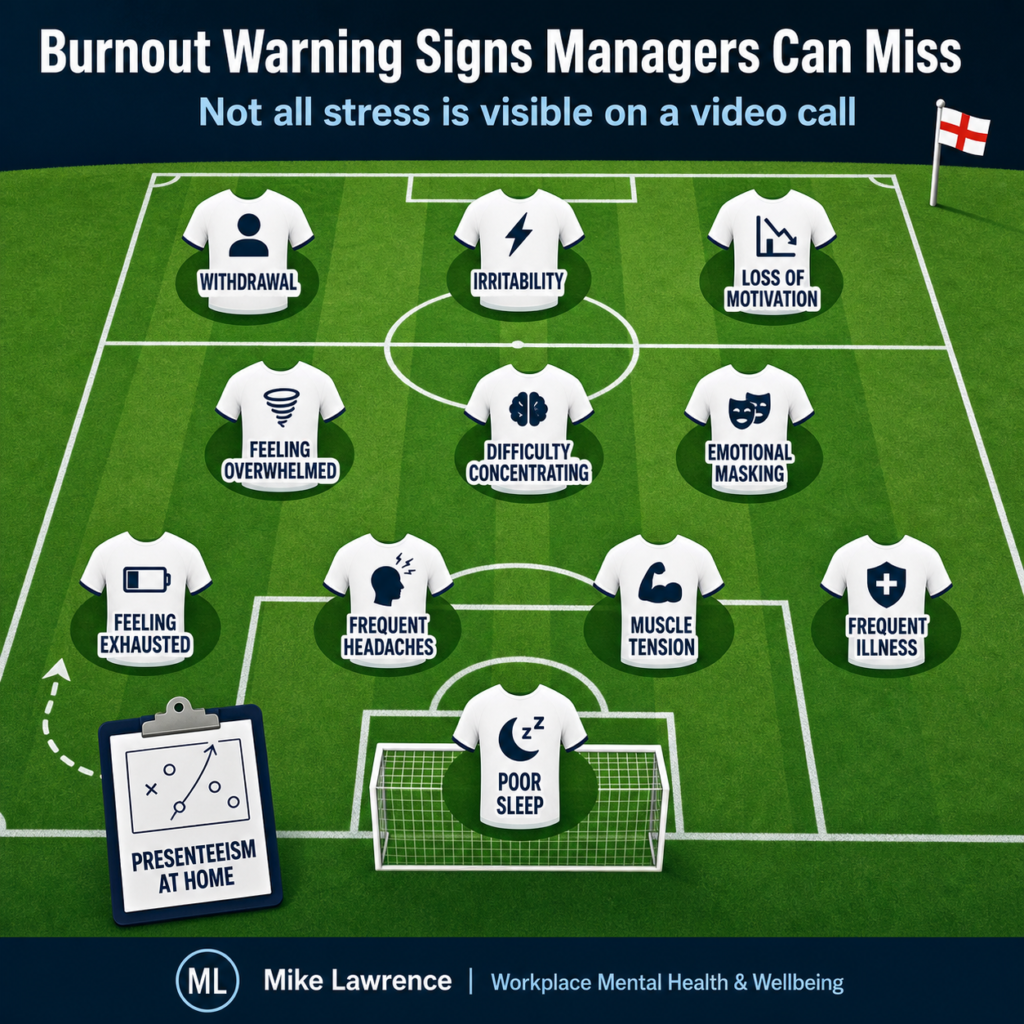
In an office, a manager may notice that someone looks withdrawn, unusually tired, more reactive, quieter than normal or less connected to the team. They may spot changes in body language, informal conversation, energy, humour or pace.
Online, those signals are easier to miss.
A person can attend a video call, nod at the right moments, reply to messages and still be struggling. They may look present while feeling overloaded. They may keep producing work while losing confidence, energy or connection in the background.
This is the workplace version of performance masking.
What I Am Seeing In Workplace Sessions
In the wellbeing, burnout and resilience sessions I deliver, this is no longer an abstract issue.
More organisations are asking for webinars and workshops around burnout, stress, resilience and coping with pressure. I am also hearing more examples of employees accessing support through EAPs and other workplace wellbeing routes, often citing workload, pressure, uncertainty or difficulty switching off.
What stands out is that many people are still functioning.
They are still attending meetings, still responding to messages and still trying to keep going.
That is why hybrid stress can be so easy to miss. The person may not look absent. They may look busy.
But busy is not always the same as coping.
Presenteeism Has Moved Home
Presenteeism used to mean being physically at work while unwell or struggling.
In hybrid and remote teams, presenteeism can happen from the kitchen table, a spare room or a sofa.
Someone may be logged in early, replying late, attending every call and still quietly running on empty. Because they are not visibly absent, the pressure can be misread as commitment. Because they keep responding, the workload can look manageable. Because they are not asking for help, people may assume they are fine.
That is a risky assumption.
Stress often becomes more serious when people feel they have to keep proving they are coping.
Managers May Miss Emotional Masking
One of the harder parts of hybrid work is that many people become skilled at compressing themselves into the version that fits the screen.
They turn the camera on.
They smile.
They say, “Yes, that’s fine.”
They finish the call and carry the pressure alone.
Emotional masking is not dishonesty. Often, it is self-protection. People may worry about being seen as difficult, unreliable or unable to cope. They may not want to burden colleagues. They may not even have the words to explain what is happening.
That is why managers need more than a quick “How are you?” at the start of a meeting.
They need a culture where people can talk about workload, uncertainty, fatigue and pressure before it becomes crisis-level.
High Performers Are Not Immune
The football fatigue conversation is useful because it challenges a common myth: that talented, disciplined, high-performing people should simply be able to push through.
But the more people carry, the more recovery matters.
The same is true at work.
Strong performers often hide stress well. They may be the ones others rely on. They may be trusted with the complex work, the urgent client, the difficult conversation, or the extra responsibility. Because they usually deliver, their stress can go unnoticed until there is a visible drop-off.
By then, the person may already be exhausted.
The aim is not to treat people as fragile. The aim is to detect pressure earlier and make support the norm.
Why This Matters For Managers And HR
If you lead a hybrid team, the risk is not only that people become stressed.
The risk is that you do not notice until stress has already affected confidence, performance, absence, retention or team trust.
By the time someone is signed off, disengaged or looking for another role, the warning signs may have been there for weeks or months.
This is why burnout support should not wait until someone reaches crisis point. It needs to be part of everyday leadership, workload conversations and manager confidence.
What Managers Can Look For
In hybrid teams, managers may need to pay closer attention to patterns rather than single moments.
Useful warning signs can include:
- reduced participation from someone who is usually engaged
- unusually short or delayed replies
- working consistently outside normal hours
- more mistakes or missed details
- irritability, flatness or withdrawal
- camera always off when it was previously on
- avoiding informal conversation
- increased sickness, lateness or last-minute cancellations
- over-apologising or repeatedly saying everything is “fine”
None of these proves someone is struggling. But they can be an invitation to check in properly.
Better Questions Help
Hybrid wellbeing does not require managers to become therapists.
It does require better conversations.
Instead of relying only on “Are you okay?”, try questions that make it easier for someone to answer honestly:
- “How manageable does your workload feel this week?”
- “Is anything taking more energy than usual?”
- “What is one thing that would make this week easier?”
- “Are there any meetings, deadlines or expectations we need to rethink?”
- “What are you noticing about your energy at the moment?”
The tone matters. These questions should not feel like surveillance or performance management. They should feel like leadership.
Hybrid Working Needs Clearer Recovery Boundaries
When work happens at home, the boundary between pressure and recovery can become blurred.
People may check one more email, answer one more message or reopen the laptop after dinner because the office is always there. Over time, this can affect sleep, concentration, relationships and emotional regulation.
Managers can help by making expectations explicit:
- when people are expected to respond
- what counts as urgent
- whether late messages need immediate replies
- how breaks are protected
- how workload is prioritised when everything feels important
Ambiguity creates pressure. Clarity reduces it.
The Practical Point
Hybrid working is not the problem by itself.
The risk comes when flexibility is combined with hidden workload, weak boundaries, limited informal contact and a culture where people feel they must always appear okay.
That is why workplace wellbeing, mental health awareness and manager confidence matter.
Teams need practical ways to notice pressure, talk earlier and respond without making people feel exposed.
If you are concerned that stress, burnout or emotional exhaustion may be going unnoticed in your team, the next step is not to wait for someone to break. It is to create safer, clearer conversations now.
You can explore support here:
- Working From Home Stress & Burnout Support: https://mikelawrence.co.uk/working-from-home-stress-burnout-support/
- Mental Health First Aid Training: https://mikelawrence.co.uk/mhfa-england-certified-mental-health-first-aid-training-online/
- Workplace Mental Health Speaking: https://mikelawrence.co.uk/speaker/
- Free Wellbeing Resources: https://mikelawrence.co.uk/free-resources/
Frequently Asked Questions
Why can hybrid working make stress harder to spot?
Hybrid working can make stress harder to spot because managers see fewer informal signals. In an office, changes in energy, mood, body language, connection and behaviour may be easier to notice. Online, someone can attend meetings, reply to messages and appear productive while still feeling overloaded, isolated or emotionally exhausted.
What are common signs of stress in hybrid teams?
Common signs can include reduced participation, shorter replies, delayed responses, working late, increased mistakes, irritability, withdrawal, avoiding informal conversation, repeated tiredness or a noticeable change in tone. None of these signs proves someone is struggling, but they may be a reason to check in properly.
What is presenteeism at home?
Presenteeism at home happens when someone continues working while unwell, exhausted or under significant pressure. They may still be logged in, attending calls and completing tasks, but their wellbeing, concentration and recovery may be suffering in the background.
How can managers support hybrid employees who may be stressed?
Managers can support hybrid employees by creating regular, safe conversations about workload, pressure, priorities and recovery. Practical questions such as “How manageable does your workload feel this week?” or “What would make this week easier?” can help people talk before stress reaches crisis point.
Is hybrid working bad for mental health?
Hybrid working is not automatically bad for mental health. For many people, it offers flexibility and better work-life balance. The risk comes when hybrid working is combined with unclear expectations, weak boundaries, isolation, excessive workload or a culture where people feel they must always appear okay.
About Mike Lawrence
An organisation should consider burnout or workplace wellbeing support when managers are seeing more stress-related conversations, more EAP use, reduced engagement, difficulty switching off, increased absence, workload pressure or uncertainty in hybrid teams. Support is most effective before people reach crisis point.
When should
Mike Lawrence is a Health and Wellbeing Consultant, MHFA England Instructor and workplace mental health speaker.
He works with organisations across the UK to strengthen wellbeing, resilience and performance through practical, real-world approaches that stand up under pressure.
His work focuses on:
– supporting leaders and managers to respond confidently to mental health challenges
– delivering Mental Health First Aid training that translates into real workplace impact
– helping organisations move beyond awareness into meaningful cultural change
– reducing burnout and building sustainable high performance
Explore More
- Working From Home Stress & Burnout Support
- Mental Health First Aid Training
- Workplace Wellbeing Support
- Mental Health Speaker
- Leadership and Resilience Workshops