AI and workplace wellbeing belong in the same conversation.
Not long ago, that question might have sounded like a sales pitch.
Now it feels like something every business owner, manager and employee needs to answer.
Recently, the King brought together AI leaders to discuss how the technology might benefit society and improve lives. It made me smile to see the King and AI in the same headline.
But it also left me with a question closer to home.
If AI gives us time back, who actually gets it?
Three Mikes and a beach
I can picture three digital versions of myself at work.
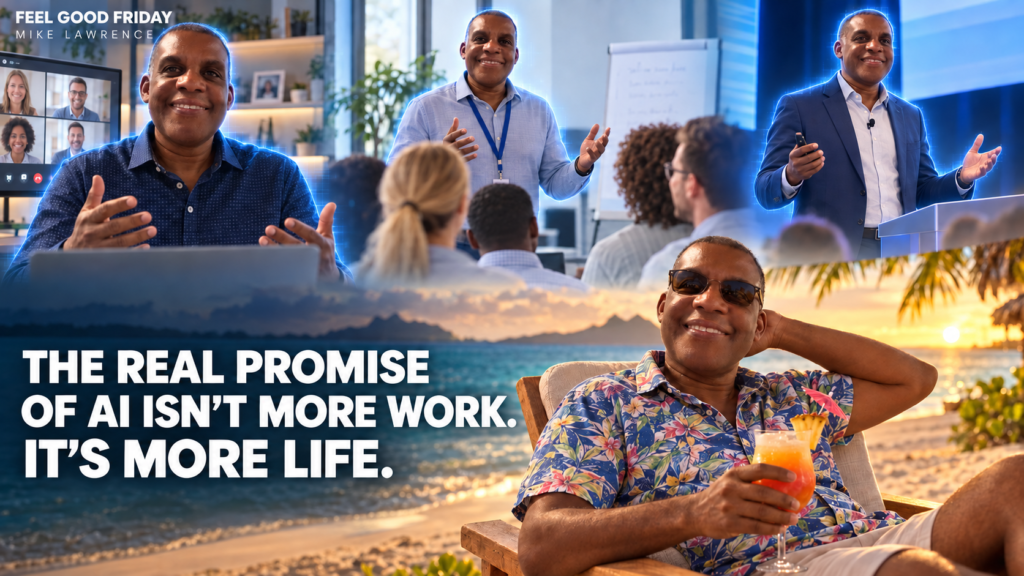
One is clearing emails. Another is preparing a presentation. The third is delivering Mental Health First Aid training while the real me is on a beach with a drink in my hand.
Before anyone asks: no, I’m not sending a digital Mike to run your MHFA course. And I certainly wouldn’t put one in front of a client for a one-to-one conversation.
I’ve already experienced digital onboarding with two organisations, though I wouldn’t claim it was AI-powered without knowing what sat behind it. It does show how quickly our ways of working are changing.
Some tasks can be made easier. Some can be automated. But there are moments when the human being is the point.
When somebody asks, “What do I say to a colleague I’m worried about?”, they need more than a polished answer. They need room to ask the awkward follow-up question, test their judgement and build confidence.
That is not where I want to save my five hours.
The time saving is real. The benefit is less clear.
In a SAP survey of 4,030 working adults, 58% said AI tools were saving them time at work. Those reporting a saving put it at an average of 52 minutes a day, nearly five hours a week.
That is a survey result, not a promise that every person or business will gain five hours.
Even so, imagine the diary space it could create. Fewer hours spent on repetitive emails, chasing information, reorganising notes or starting every document from a blank page.
Wonderful. Until the space fills up again.
An extra meeting appears. Another deadline moves forward. The expectation quietly becomes: You can do this faster now, so you can do more.
The five hours disappear before anybody has had a chance to enjoy them.
We often say there aren’t enough hours in the day. AI may give some of them back. But a faster tool won’t help much if we treat every free minute as a gap to fill.
Saving time and easing pressure are not the same thing.
For someone already stretched, that distinction matters. AI could remove the admin that keeps them working late. It could also increase the volume of work they’re expected to carry. The technology doesn’t make that decision. People do.
I’m curious about AI. I’m not handing it the keys.
I’ve worked with computer technology for many years, so I’ve been fascinated by what AI can do. Since ChatGPT arrived, I’ve moved well beyond writing the occasional prompt.
I’ve explored AI support for notes, diary organisation, CRM work and projects across my business. At last count, I had around six specialist AI roles configured. They can help me research, organise and draft, but I still review the work and make the decisions.
That learning curve has been exciting. It has also taught me how easy it is to get distracted by a clever tool before asking whether it solves a real problem.
A key takeaway from an FSB course I attended was simple: start with the outcome, then choose the tool.
That means being honest about the outcome we want. Is it better service? Less repetitive work? More time to think? A healthier working day?
Or are we buying technology because everyone else seems to have bought it?
What about the people expected to use it?
Reading John Hope Bryant’s Capitalism for All has raised another question for me: what happens to people who can see AI changing their work but haven’t been given the skills to move with it?
New specialist titles are appearing. A UK careers article lists roles including Chief AI Officer, AI trainer and AI governance manager. It’s an interesting snapshot of advertised jobs, not a guarantee that everyone can step into one.
And that is the point.
You may not need a Chief AI Officer. You probably do need to decide which tools your people can use, train them properly, and help them see how their roles might develop.
Otherwise, AI saves the company five hours while the employee wonders where they fit.
Training cannot be reserved for the people who already feel confident experimenting. Nor can a business expect staff to work everything out alone, using a jumble of tools with no shared guidance.
Give people approved tools. Give them time to learn. Give them a say in where AI helps and where human judgement must remain.
AI and workplace wellbeing: more work, or more life?
I’m not suggesting every saved hour should become an early finish. Businesses need to serve customers, stay viable and invest in what comes next.
But the benefit doesn’t have to belong entirely to one side.
Some of that time could improve the work. Some could help people learn new skills. And some could mean a proper lunch break, a less frantic journey home or the headspace to have a conversation that shouldn’t be rushed.
That is a workplace wellbeing decision, not merely an IT decision.
So I keep coming back to the question prompted by the King’s meeting with AI leaders:
If this technology is meant to improve lives, will we notice that improvement in our own working lives?
If AI saved you five hours next week, what would you do with them?
And perhaps the harder question: would you be allowed to?
Further reading
- The King’s AI summit — The Royal Family
- AI saves employees time, but who benefits? — SAP’s survey, published as paid content on Forbes
- New AI job titles in the UK — MyPerfectCV