My mum was part of the Windrush generation.
That is one reason Black History Month feels personal to me.
For Windrush Day in June 2026, Sheffield held a civic gathering to honour Windrush elders. I received an invitation and passed it on to Mum. I was glad she could attend. Sheffield City Council
I also know that some people in the community were unaware of the event. I do not say that to take anything away from it. It made me think about how we reach the people whose stories we say we want to honour.
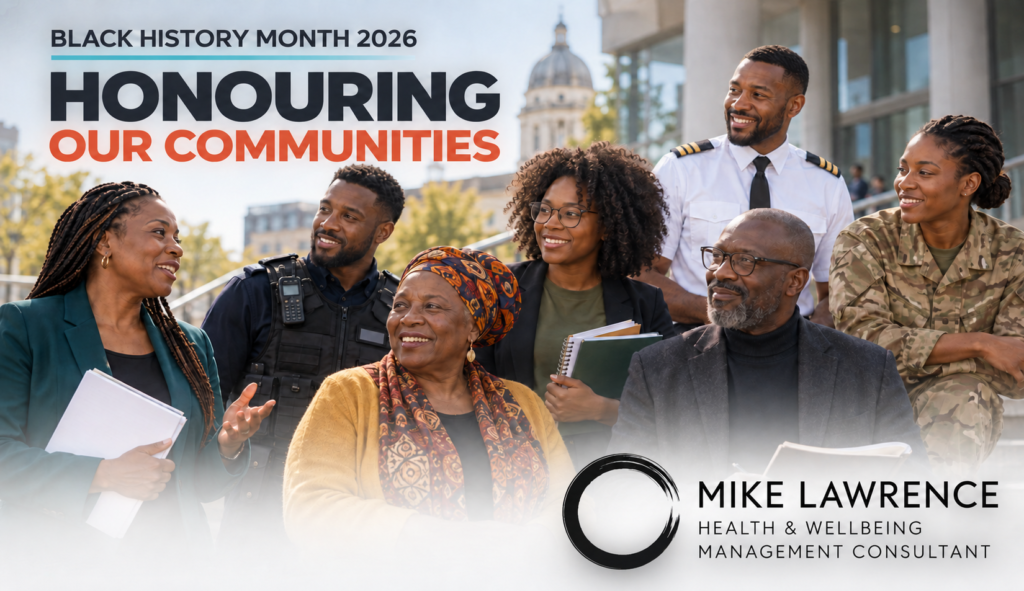
This year’s Black History Month theme is Honouring Our Communities. But communities need places to come together, not only occasions to be celebrated. Some of the centres I remember have closed. Younger generations are building their lives and connections differently. That is not their fault, but it does change how stories get passed on. Black History Month UK
We sometimes joke that the only time everyone gets together now is at a wedding or a funeral. There is affection in that joke. There is a little sadness too.
More than a month in the calendar
Black History Month has been marked in the UK since 1987. I value the stories it brings forward, but I would rather see Black history taught throughout the school year as part of British history. House of Commons Library
That learning belongs in businesses as well as schools.
Earlier this year, MHFA England asked me to host a webinar, Redcoat, Racism and Hope. I talked about language and what it is like to grow up while the words other people use for you keep changing: brown, “coloured”, Black.
Imagine being a child at play and someone calls you a name they picked up from a jam-jar label. Or sitting in a comedy club while the comic reels off innuendo after innuendo about colour. Other people laugh. You are left deciding whether to laugh along, object, or pretend it did not land.
Those moments may look small to somebody watching. They do not always feel small to the person carrying them.
Colour-based labels have a long history. A colonial-era account held by The National Archives describes events in 1609 using such terms for Africans caught up in the trade in enslaved people. That is not a claim that the words were first used in 1609. It shows how far back this way of classifying people appears in the records.
A person can be Jamaican, British, a parent, a colleague, a neighbour, with a name and a life of their own. Yet somebody else may decide that the first thing worth knowing about them is their colour.
What does that do to a person over time?
Sheffield’s two histories
Sheffield is known for steel and cutlery. It also has an abolitionist history. Mary Anne Rawson and her mother Elizabeth helped found the Sheffield Female Anti-Slavery Society in 1825. Their work deserves recognition. University of Sheffield Archives
So does the history we hear less often.
University of Sheffield researchers have documented the city’s material and financial connections to the Atlantic slave economy. In their history of racism video, they describe Robert Haynes Junior and Elizabeth Haynes receiving approximately £17,582 in compensation connected to 813 enslaved Africans in Barbados. The family was recorded living in Sheffield in the 1841 census, around five years after the payout.
The compensation went to people connected with ownership. The people who had been enslaved received none.
Sheffield’s abolitionists and its links to slavery are not competing stories. We should be honest about both.
A chapter that has not ended
When reparations are discussed, I often hear, “That was a long time ago.”
It was. But the decisions about who received compensation, and who did not, are facts about Britain’s past. On 7 September 2026, Jamaica filed a petition addressed to King Charles III seeking legal answers about slavery and reparations. People will disagree about what should follow, but the question is plainly not closed. Jamaica Information Service
The Windrush scandal is another reason this history feels close to home. People who had lived and worked in Britain for decades were wrongly treated as though they had no right to be here. Some lost jobs or access to services; others faced detention or removal. UK Government
In the Sheffield video, one researcher says “the final chapter in Sheffield’s links to slavery cannot yet be written.”
I think about that when people ask why Black History Month is still needed.
Black History Month and Mental health
I have experienced racism at school, at work and elsewhere. I also support people of colour facing it in workplaces today. So I cannot talk about mental health without asking whether someone feels safe enough to speak, and what happens when they do.
Centre for Mental Health has reported that five times as many Black people as White people are diagnosed with schizophrenia. England’s 2024–25 figures show that the Mental Health Act detention rate for people recorded as Black or Black British was nearly four times that for people recorded as White. NHS England Digital
Those figures do not offer a single, simple explanation. They do, however, give us good reason to examine trust, access, treatment, and people’s experiences of services. Recent survey reporting also found that people in Black, Asian and Mixed ethnic groups were less likely to receive mental health treatment than White British people. That is not the same as saying they did not want help. Mental Health Foundation
I have also been reading John Hope Bryant’s Capitalism for All. He argues that opportunity is not a favour handed to a few people. When talent is overlooked, everybody loses.
McKinsey’s US research puts numbers against that idea. One scenario found that fairer access to jobs and pay could bring around one million additional Black people into employment and increase Black wages by approximately $220 billion a year. Separate research estimated that closing the racial wealth gap could benefit the US economy by $1 trillion to $1.5 trillion by 2028. McKinsey on employment; McKinsey on the wealth gap
Read that again. Up to $1.5 trillion.
It is a US estimate, not a number we can transfer to Britain. But the principle travels: when Black men and women, and people from other overlooked communities, have a fairer chance to develop skills, find work, progress and build businesses, the benefits do not stop with them.
A moment I’m looking forward to
I’m going to Manchester in October to hear Barack Obama speak, which has been on my bucket list for years, so I’m looking forward to seeing him in Manchester this October during Black History Month.
His election was a moment many of us remember vividly. I’m interested in what he has to say now about humanity and giving people hope in a rapidly changing world, if it’s on the agenda.
What happens after October?
I am glad Mum got to attend Sheffield’s Windrush gathering. I hope there will be more chances for her generation to be heard, and more everyday spaces where younger people can hear their stories.
Honouring a community means celebrating its contributions. It also means listening to its experiences, teaching its history honestly, and removing barriers that still limit people’s health and opportunities.
A month can open that conversation. Schools, employers and communities decide whether it continues.
The final chapter has not been written. We still have a say in what comes next.
— Mike