Shining a Light on the Hidden Figures Who Helped Shape Our World
Remarkable minds. Extraordinary achievements. Stories that deserve to be told.
As we celebrate Black History Month 2026, this week’s Feel Good Friday shines a light on remarkable Black pioneers whose achievements transformed technology, innovation, business and human rights. Some are household names, while others helped change the world without receiving the recognition they deserve.
What do Sidney Poitier, Martin Luther King Jr. and Muhammad Ali have in common?
Three extraordinary Black men. Three very different journeys. Three individuals whose achievements went far beyond their professions and helped change the world.
🎬 Sidney Poitier – Breaking barriers on Hollywood’s silver screen
A trailblazer who challenged racial stereotypes and barriers in an industry where opportunities for Black actors were severely limited.
In 1964, Poitier became the first Black man to win the Academy Award for Best Actor for Lilies of the Field. His remarkable talent and presence helped transform how mainstream cinema represented Black actors.
Read more about Sidney Poitier – The Academy
✊🏾 Dr Martin Luther King Jr. – A dream that inspired a movement
One of the most influential voices of the American civil rights movement. On 28 August 1963, King delivered his historic I Have a Dream speech at the March on Washington.
His words helped define a movement for racial equality. Through nonviolent protest and determined leadership, King challenged segregation and discrimination, helping build momentum for the Civil Rights Act of 1964 and the Voting Rights Act of 1965.
Explore Dr King’s life and legacy – Stanford’s King Institute
🥊 Muhammad Ali – Float like a butterfly, sting like a bee
Who could forget the legendary Rumble in the Jungle against George Foreman in 1974 or the unforgettable Thrilla in Manila against Joe Frazier in 1975?
Ali’s charisma, skill and confidence made him one of the most recognisable athletes in the world. But his influence extended beyond boxing. His outspoken positions on racial justice, religion and the Vietnam War came at an enormous personal and professional cost.
Ali demonstrated that greatness isn’t measured only by victories or titles, but also by the courage to stand up for what you believe.
Explore Muhammad Ali’s life – Muhammad Ali Center
Three household names. Three extraordinary legacies.
Most of us have heard of them. We recognise their names, their achievements and the barriers they helped overcome.
But what about the thousands of other remarkable Black individuals whose names may be unfamiliar, yet whose ingenuity, courage and determination helped shape the way we live today?
Who helped make electric lighting more practical? Who pioneered improvements to traffic signals? Who helped develop microphone technology used in our everyday devices? Whose mathematical brilliance contributed to GPS? And who helped establish the early computer industry in Silicon Valley?
These aren’t simply interesting historical footnotes. Their contributions still shape our everyday lives, often without us even knowing their names.
As we recognise Black History Month this October, I want to dedicate this week’s Feel Good Friday to some of these lesser-known pioneers and what their stories teach us about resilience, recognition, opportunity, and human potential.
Black History Month 2026: Recognising the pioneers behind everyday innovation
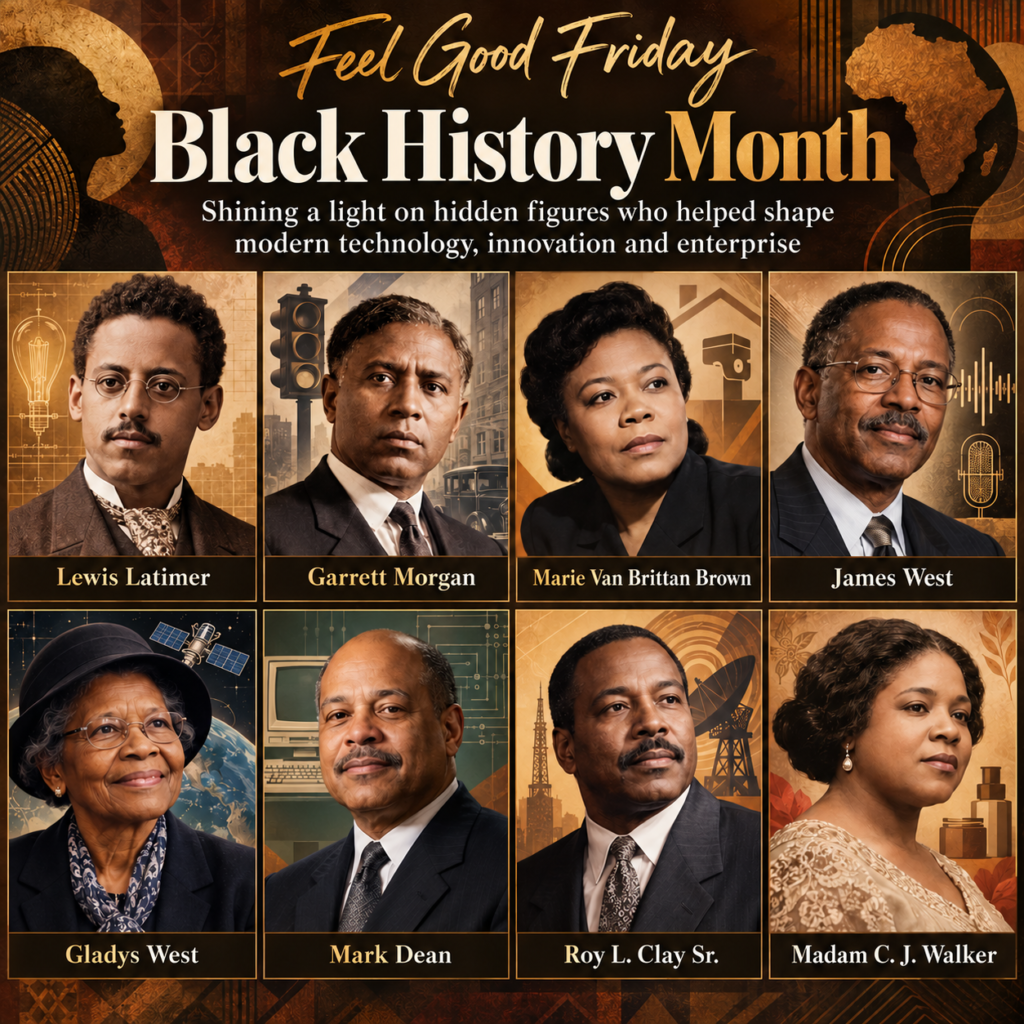
Let’s shine a light on eight remarkable people who helped change our world.
💡 1. Lewis Latimer (1848–1928) – Helping to illuminate the world
When someone mentions the electric light bulb, whose name springs to mind? Thomas Edison, perhaps? But how many people know of Lewis Latimer?
Born in Massachusetts to parents who had escaped slavery, Latimer became a talented inventor, engineer and technical draughtsman. In 1882, he patented an improved method of manufacturing carbon filaments, contributing to the development of practical, mass-produced electric lighting.
He also prepared important patent drawings for Alexander Graham Bell’s telephone. Those achievements place him in the story of two technologies that transformed how people lived and communicated.
A reminder that extraordinary ability is not determined by someone’s circumstances at birth.
Discover Lewis Latimer – Lewis Latimer House Museum
🚦 2. Garrett Morgan (1877–1963) – Making our roads safer
Millions of us encounter traffic lights every day, often without thinking about the inventors who improved them.
Born in Kentucky to formerly enslaved parents, Morgan had limited formal schooling but became a remarkably resourceful inventor and entrepreneur. In 1923, he patented a three-position traffic signal with an added warning stage to improve road safety.
He did not invent the first traffic signal, but his design was an important contribution to traffic-control development. He also created a protective breathing hood, an early innovation in respiratory safety equipment used during a dramatic 1916 rescue after an explosion beneath Lake Erie.
Innovation isn’t always about inventing something entirely new. Sometimes it’s about making something better, safer or more accessible.
Explore Garrett Morgan’s legacy – US Federal Highway Administration
🏠 3. Marie Van Brittan Brown (1922–1999) – A pioneer of home security
Long before video doorbells, home CCTV and smart security systems, there was Marie Van Brittan Brown.
A nurse in Queens, New York, Brown often worked irregular hours and worried about her home’s safety. Alongside her husband, Albert, she devised a system using a movable camera, television monitor, two-way communication and a remote door-release mechanism.
The couple filed their patent application in 1966, and the patent was granted in 1969. Their system anticipated features now familiar in household security technology.
Sometimes a powerful innovation begins with a simple question: ‘Surely there must be a better way?’
Read more about Marie Van Brittan Brown – Smithsonian Magazine
🎤 4. James West (born 1931) – Helping the world communicate
Have you made a call, joined an online meeting or recorded a voice message today? You may have benefited from James West’s work.
At Bell Laboratories, West co-invented the electret microphone with Gerhard Sessler in 1962. This compact, sensitive, and cost-effective technology later became widely used in telephones, hearing aids, computers, and recording equipment.
West went on to hold numerous patents and advocate for greater opportunities in science and engineering for young people from underrepresented backgrounds.
His story is a wonderful reminder that you should never underestimate the power of curiosity.
Discover James West – National Inventors Hall of Fame
🌍 5. Dr Gladys West (1930–2026) – Helping us find our way
Imagine travelling somewhere unfamiliar without GPS, satellite navigation or directions on your mobile phone.
Growing up in segregated rural Virginia, Gladys West excelled in mathematics and pursued an education despite the barriers around her. In 1956, she joined a US Navy research facility, where she later used satellite observations and complex calculations to help create highly accurate models of the Earth’s shape.
Her mathematical work helped lay the foundations of modern GPS technology, yet the wider public knew little about her role for decades. The US Air Force inducted her into the Space and Missile Pioneers Hall of Fame in 2018.
Dr West died on 17 January 2026, aged 95, leaving an extraordinary scientific legacy.
Sometimes the people who help the world move forward are the ones quietly working behind the scenes.
Learn about Dr Gladys West – The Lemelson Foundation
💻 6. Dr Mark Dean (born 1957) – Helping bring computers into everyday life
When we think about the rise of personal computers, names such as IBM, Microsoft and Apple often dominate the conversation. Dr Mark Dean deserves a place in that history.
Joining IBM in 1979, he contributed to the original IBM personal computer, launched in 1981, and held three of its nine original patents. His work on computer bus architecture helped machines connect with additional components and peripherals.
Dean later contributed to the development of gigahertz-speed processor technology, and in 1995 became IBM’s first Black American IBM Fellow.
From homes and classrooms to workplaces and hospitals, his contributions helped shape the personal computing era.
Read about Dr Mark Dean – IBM History
🖥️ 7. Roy L. Clay Sr. (1929–2024) – The Godfather of Silicon Valley
Here’s a name I suspect many people haven’t heard before.
Roy L. Clay Sr. was a pioneering computer scientist, engineer, entrepreneur and technology leader. In 1965, he joined Hewlett-Packard, becoming a founding member of its computer division and leading the team behind its first computer, the HP 2116A, introduced in 1966.
His influence extended beyond engineering into business leadership, investment advice and creating opportunities for people underrepresented in the technology industry. He later established ROD-L Electronics, specialising in electrical safety testing equipment.
These achievements helped earn him the nickname ‘The Godfather of Silicon Valley’.
Leadership isn’t only about what we achieve ourselves. It’s also about the opportunities we help create for others.
Read the story of Roy L. Clay Sr. – Hewlett-Packard History
💼 8. Madam C.J. Walker (1867–1919) – From poverty to extraordinary enterprise
Born Sarah Breedlove in Louisiana to formerly enslaved parents, Madam C.J. Walker experienced poverty, hardship and racial discrimination. Yet she went on to build an extraordinary haircare business.
Recognising that Black women’s haircare needs were often neglected, she developed and marketed specialist products and built a network of sales agents that created earning opportunities for thousands of women.
Guinness World Records recognises Walker as America’s first self-made female millionaire, regardless of race. Other women may have reached the milestone earlier, but their wealth is less conclusively documented. Walker was not the first millionaire overall.
What fascinates me isn’t simply the wealth she accumulated. It’s the opportunities she created for other women to earn, develop skills and build independence.
Success becomes even more meaningful when it enables other people to succeed.
Explore Madam C.J. Walker’s record – Guinness World Records
🌟 Beyond technology: Two more extraordinary stories
While the eight people in this week’s collage transformed technology and enterprise, two more lives illustrate another side of courage, opportunity and recognition.
🎭 Josephine Baker (1906–1975) – Entertainer, resistance fighter and civil rights champion
Josephine Baker is remembered as a dazzling singer and dancer who became an international star after moving from the United States to France. But her life extended far beyond the stage.
During the Second World War, Baker used her fame, connections and freedom to travel to assist intelligence work for the French Resistance and the Free French cause. She later spoke out against racial discrimination and supported the civil rights movement.
On 30 November 2021, Baker became the first Black woman honoured with induction into France’s Panthéon, recognising her contribution to the nation and its values.
Sometimes the most extraordinary part of someone’s story is the part we know least about.
Read about Josephine Baker’s Panthéon honour – BBC News
⚖️ Navi Pillay (born 1941) – A lifetime of fighting for justice
And finally, a remarkable story that brings us right up to October 2026.
On 9 October 2026, South African jurist Navanethem ‘Navi’ Pillay was named the 2026 Nobel Peace Prize laureate for her efforts to promote peace and international law.
Born into a family of Indian Tamil heritage during apartheid, Pillay faced racial and gender discrimination. In 1967, she established her own legal practice in Natal, becoming the first woman to do so in the province, and defended anti-apartheid activists.
She later served on South Africa’s High Court, at the International Criminal Tribunal for Rwanda and as United Nations High Commissioner for Human Rights. Her contribution to international justice includes work advancing legal recognition of sexual violence as a crime that can constitute genocide.
Being denied an opportunity does not mean someone lacks the ability to succeed. Sometimes the barriers we challenge today create opportunities for generations we may never meet.
Discover Navi Pillay’s Nobel Peace Prize – Norwegian Nobel Committee
❤️ What can we learn from these remarkable lives?
As I explored these stories, one thought kept returning to me.
Talent is everywhere. Opportunity isn’t always.
Each of these individuals had abilities, ambitions, ideas, and determination. Yet many encountered barriers unrelated to their intelligence, competence, creativity or potential.
Some faced discrimination in education and employment. Others were excluded from professional opportunities, had their work overlooked or had to build their own enterprises when doors remained closed.
Yet their achievements changed the way we live, work, travel, communicate, and understand the world.
How much human potential has the world lost because someone was never given the opportunity to demonstrate what they could achieve?
As someone who works in mental health, wellbeing and leadership, I see a powerful connection here.
When people feel valued, respected, included and psychologically safe, they are better placed to share ideas, challenge assumptions and contribute their talents. When individuals experience prejudice, exclusion or barriers to opportunity, we all risk losing out.
We often talk about diversity and inclusion through policies, programmes and workplace initiatives. But ultimately, it’s about people: recognising potential, creating opportunity, listening to different perspectives and challenging assumptions about what someone can achieve.
Imagine what becomes possible when we create environments where people have a genuine opportunity to show what they’re capable of.
That’s not simply good leadership. It’s good humanity.
✨ My Feel Good Friday reflection
Black History Month gives us an important opportunity to celebrate achievements, acknowledge injustice, and learn about people whose contributions haven’t always received the recognition they deserve.
But that recognition shouldn’t stop in October.
The innovations, businesses and achievements explored here continue to influence everyday life throughout the year. And countless more stories are waiting to be discovered.
History isn’t just about the names we remember. It’s also about the people whose contributions made the world we know possible.
Perhaps the question isn’t simply how many of these individuals we recognise. Perhaps it’s also how we can recognise the talent and potential of those around us today.
Because somewhere, right now, another Lewis Latimer, Gladys West, Roy Clay, or Madam C.J. Walker may be waiting to be recognised.
And what a difference the right opportunity could make.
💬 I’d love to hear your thoughts. How many of these remarkable individuals did you already know about? Whose story surprised or inspired you most? Perhaps you know another overlooked pioneer whose achievements deserve recognition. Please share their story.
Have a wonderful Feel Good Friday and a fantastic weekend! 🙌
Mike Lawrence
Health & Wellbeing Management Consultant | Mental Health First Aid Instructor | Speaker
Topics: Black History Month, Hidden Figures, Innovation, Diversity and Inclusion, Leadership, Human Potential