Every May, Mental Health Awareness Week encourages workplaces across the UK to pause and talk more openly about wellbeing, burnout, leadership, and psychological safety.
Footballers speak openly about pressure. Leaders share supportive messages. LinkedIn fills with awareness campaigns. Broadcasters discuss burnout, anxiety, stress, and resilience between matches and interviews.
And for one week, something interesting happens:
👉 workplaces suddenly become more emotionally honest.
Even in sport — an environment once built around “just get on with it” — the conversation has shifted.
People are talking more openly than ever before.
And honestly?
That matters.
Mental Health Awareness Week plays an important role in helping organisations, leaders, and employees pause long enough to acknowledge something many people silently carry every day:
👉 pressure.
But once the awareness week banners come down, an important question still remains:
👉 what happens on the other 51 weeks of the year?
2026 Update: Two Months Later, What Has Actually Changed?
Back in May, there was a lot of conversation around mental health at work.
Awareness days matter. They give people permission to talk, reflect and open up.
But two months later, the real question is:
what changed?
The World Health Organization has reported that more than 1 billion people are living with mental health disorders worldwide. That is not just a global health statistic. It shows up in workplaces, families, teams and everyday conversations.
In the UK, the Health and Safety Executive’s First Aid at Work guidance also makes clear that employers should consider employees’ mental health when carrying out first-aid needs assessments.
So maybe the next step is not another poster, campaign or awareness day.
Maybe it is confidence.
Confidence to notice.
Confidence to listen.
Confidence to respond.
Confidence to signpost someone when they need support.
Because awareness matters.
But action is what changes culture.
Because in many workplaces, the real challenge is not getting people to talk about mental health for one week.
It is creating environments where people still feel psychologically safe enough to speak honestly:
- during uncertainty
- during organisational change
- when workloads rise
- when targets are missed
- when burnout quietly builds beneath the surface
- when managers themselves are struggling
That is where workplace culture is truly revealed.
Mental Health Awareness Week Is Reflecting A Bigger Workplace Shift
One of the clearest shifts in recent years is that younger generations increasingly view workplace wellbeing very differently from previous generations.
For many employees today, success is no longer defined purely by salary, job title, or long hours.
Increasingly, people are looking for:
- flexibility
- healthier work-life integration
- psychologically safe workplaces
- emotionally intelligent leadership
- organisations whose values genuinely align with their own
Research highlighted in The Future Workplace Report by Oktra suggests many younger workers now prioritise wellbeing, flexibility, and purpose above traditional career markers alone.
In simple terms:
👉 people are increasingly voting with their feet.
Younger generations are no longer simply choosing salaries.
👉 they are choosing cultures.
Organisations failing to create healthier workplace cultures are often experiencing:
- higher turnover
- disengagement
- burnout
- recruitment challenges
- growing management pressure
This is no longer simply a wellbeing conversation.
It is increasingly becoming:
👉 a workforce and business sustainability conversation.
The Three Organisational Responses I Commonly See
Over the years, I’ve noticed many organisations tend to fall into one of three broad groups when it comes to workplace wellbeing and mental health.
The first are organisations genuinely trying to build healthier cultures.
These businesses increasingly recognise that wellbeing affects:
- engagement
- retention
- communication
- leadership
- performance
Mental health is not treated as a side project or awareness-week campaign.
It becomes part of leadership conversations, management development, communication, and workplace culture itself.
These organisations are often asking deeper questions:
- How do we improve manager confidence?
- How do we reduce burnout?
- How do we create psychologically safer workplaces?
- How do we retain good people long term?
Importantly, they recognise something many employees already understand:
👉 wellbeing and performance are not opposites.
Long term, they are deeply connected.
The second group still tends to view wellbeing primarily through the lens of operational cost.
Support becomes reactive rather than preventative.
Conversations often happen only when:
- absence rises
- complaints increase
- retention becomes difficult
- performance drops
- legal or reputational concerns emerge
And let’s be honest:
👉 these organisations still exist.
The challenge is that modern employees increasingly notice the gap between:
👉 what organisations say publicly
and
👉 what employees actually experience internally.
The third category is perhaps the most interesting of all:
👉 “wellbeing washing.”
Some organisations appear highly engaged externally through awareness campaigns, branded initiatives, social media messaging, or wellbeing statements, while internally employees may experience something very different.
Sometimes wellbeing activity exists because:
- policies require it
- tenders reference it
- funding applications ask about it
- organisations feel expected to demonstrate “something”
The danger?
Employees know when wellbeing is genuine…
and they know when it’s just another campaign.
Managers Are Being Asked to Carry More Than Ever
There is another layer to this conversation that is rarely discussed openly enough.
Many organisations are simultaneously expecting more from managers while investing less in development and support.
Despite increasing expectations around:
- wellbeing
- leadership
- psychological safety
- difficult conversations
- burnout prevention
- engagement
- hybrid working
- retention
research suggests investment in workplace training has actually declined significantly in real terms over recent decades.
Some workforce studies suggest employer investment in training per employee has fallen by around 36% since 2005, while average workplace training days have also reduced over time.
At the same time, many organisations still focus large portions of training budgets on:
- compliance
- procedural learning
- mandatory requirements
- risk management
rather than deeper investment in:
- leadership capability
- communication
- emotional intelligence
- resilience
- psychologically safe cultures
- people management skills
That leaves many managers caught in an incredibly difficult position.
Expected to:
- support wellbeing
- maintain morale
- navigate difficult conversations sensitively
- manage pressure
- lead through uncertainty
- and still deliver operational performance
…often while receiving limited support themselves.
And perhaps that explains why so many organisations are now searching for:
- shorter wellbeing sessions
- practical workshops
- lunch-and-learns
- Mental Health Awareness Week talks
- leadership wellbeing conversations
- psychologically safer ways to support teams
Organisations Are Trying to Find the Balance
One thing I have genuinely noticed over recent years is a significant increase in organisations booking:
- lunch-and-learn sessions
- Mental Health Awareness Week webinars
- short wellbeing talks
- leadership conversations
- one-hour workshops
- 90-minute interactive wellbeing discussions
That tells its own story.
Most organisations are not struggling because they don’t care.
They are struggling because they are trying to support employee wellbeing while simultaneously navigating:
- stretched budgets
- operational pressure
- retention challenges
- rising absence
- burnout
- workforce shortages
- changing employee expectations
all at the same time.
In many conversations I have with managers and leadership teams, there is often a genuine desire to “do the right thing” — but also uncertainty around:
👉 what meaningful support actually looks like in practice.
That uncertainty is real.
The EAP Challenge — Support That Many Employees Never Use
Another interesting shift happening across workplace wellbeing is the growing conversation around Employee Assistance Programmes (EAPs).
Many organisations now provide:
- counselling lines
- wellbeing apps
- support portals
- helplines
- mental health resources
On paper, this sounds positive.
And in some organisations, these services genuinely help employees access valuable support.
However, despite many larger employers now offering EAP services, utilisation rates often remain surprisingly low.
Guidance and insight from EAPA UK and wider industry reporting continue to highlight ongoing challenges around:
- awareness
- trust
- accessibility
- employee engagement
That raises an uncomfortable but important question:
👉 if support exists but employees do not trust, access, or use it, how effective is it really?
In many workplaces, employees still quietly wonder:
👉 “If I use this support, how will I be viewed?”
Others simply do not engage because the support can feel:
- generic
- reactive
- impersonal
- disconnected from everyday workplace culture
This may partly explain why many organisations are increasingly exploring more visible, proactive, and conversation-led approaches to wellbeing support.
At the same time, research from Deloitte UK — Mental health and employers: The case for investment continues to suggest that proactive investment in workplace wellbeing can generate measurable returns through:
- improved retention
- reduced absence
- stronger engagement
- healthier cultures
- improved productivity
Which raises another important question:
👉 if poor wellbeing already carries a financial cost, can organisations really afford not to take meaningful action?
Why Mental Health First Aid Still Matters
This is where Mental Health First Aid training often becomes part of a much bigger workplace conversation.
Not because one course suddenly “solves” workplace wellbeing.
And not because managers are expected to become therapists.
But because many managers simply want greater confidence when real conversations arise.
Often the biggest fear leaders have is not lack of care.
It is:
👉 not knowing what to say.
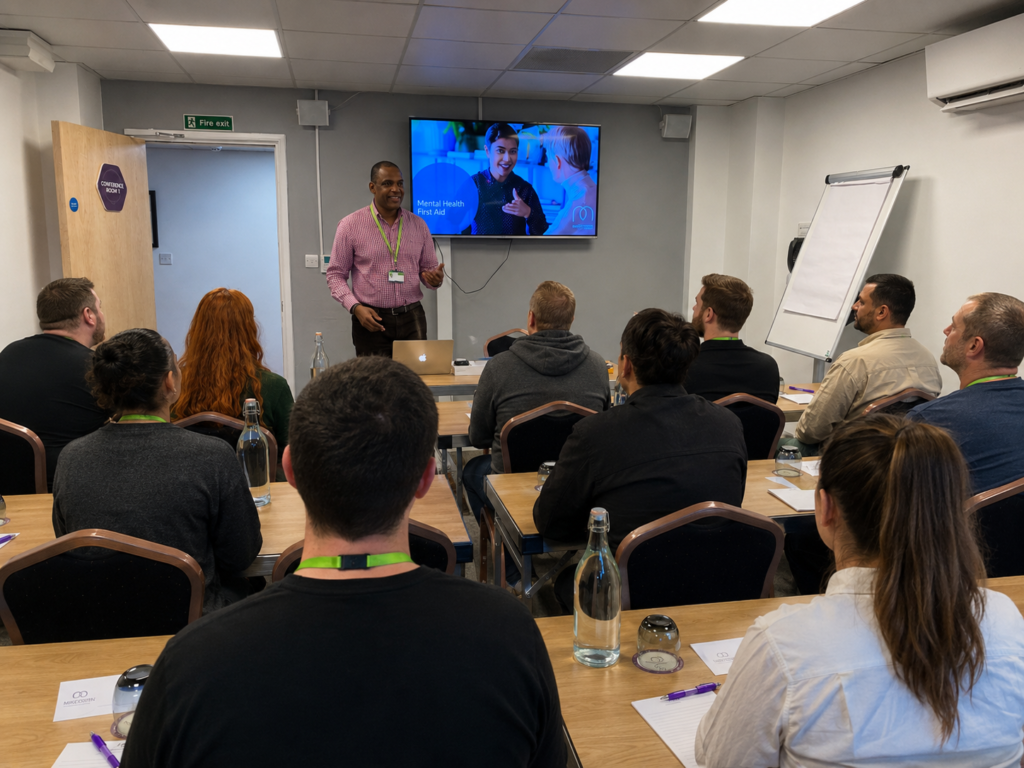
Mental Health First Aid training can help organisations improve awareness, reduce stigma, encourage earlier conversations, and help people feel more prepared when difficult situations arise at work.
One participant recently described the experience by saying:
“Mike made an uncomfortable subject approachable. He is a supportive and knowledgeable instructor.”
Another reflected:
“Yes, the subject matter was difficult at times, but Mike’s patience and support made a huge difference.”
And sometimes the most important thing a leader can say is simply:
👉 “Thank you for telling me.”
Not immediately thinking:
👉 “I haven’t got time for this.”
Not avoiding the conversation.
Not instantly shifting back to targets, deadlines, or operational pressure.
Just actively listening without judgement.
That sounds straightforward.
But under pressure, it can be surprisingly difficult.
Is Mental Health Following the Same Path as Physical First Aid?
It’s interesting to reflect on how workplace attitudes toward physical first aid once evolved.
Today, physical first aid feels completely normal.
Trained first aiders, accident procedures, and visible health and safety systems are simply accepted parts of workplace culture.
But historically, even physical health and safety measures were sometimes viewed as:
- unnecessary
- disruptive
- expensive
- “extra”
Now they are embedded into organisational responsibility.
Which raises an interesting question:
👉 are we currently witnessing a similar transition with mental health?
Mental Health First Aid is not a legal requirement in the UK in the same way physical first aid is.
However, expectations around:
- psychological safety
- leadership responsibility
- burnout
- emotionally intelligent management
- workplace wellbeing
are clearly evolving.
And perhaps the bigger question is no longer:
👉 “Should organisations support mental health?”
But instead:
👉 “What does meaningful support actually look like in practice?”
Final Reflection
Mental Health Awareness Week matters.
Awareness matters.
But culture is revealed long after the campaigns end.
In the conversations managers avoid.
In the pressure leaders carry silently.
In whether employees genuinely feel safe enough to say:
👉 “I’m not OK.”
Because real workplace wellbeing is not built through awareness alone.
It is built through:
- trust
- leadership
- communication
- psychological safety
- emotionally honest conversations
Every single day.
If your organisation is exploring Mental Health First Aid training, workplace wellbeing conversations, or leadership speaking sessions around resilience, psychological safety, and mental health at work, you can learn more here:
MHFA Training:
https://mikelawrence.co.uk/mhfa-england-certified-mental-health-first-aid-training-online/
Workplace Speaker Sessions:
https://mikelawrence.co.uk/speaker/
If your organisation marked Mental Health Awareness Week but is now asking what comes next, this is where practical training can help.
Mental Health First Aid training and refresher sessions are not about turning people into therapists.
They are about helping people feel more confident when mental health stops being a campaign message and becomes a real conversation.
Upcoming sessions:
MHFA England Training — 27–28 July 2026
https://mikelawrence.co.uk/product/mhfa-england-training-27-28-july-2026-live-online-2-day-course/
MHFA Refresher — 18 August 2026, 9:00am–1:00pm
https://mikelawrence.co.uk/product/mental-health-first-aid-refresher-18-august-2026/
Mike Lawrence
Workplace Mental Health Speaker | MHFA England Instructor | Health & Wellbeing Consultant
Sources & Further Reading
Deloitte UK – Mental health and employers: The case for investment
https://www2.deloitte.com/uk/en/pages/consulting/articles/mental-health-and-employers.html
Oktra – The Future Workplace Report
https://www.oktra.co.uk/guidance/guides-checklists/the-future-workplace-report/
CIPD – Learning at Work Report
https://www.cipd.org/uk/knowledge/reports/learning-work/
EAPA UK – Employee Assistance Programme insights and guidance
https://www.eapa.org.uk/
Mind – Workplace mental health resources
https://www.mind.org.uk/workplace/mental-health-at-work/
MHFA England
https://mhfaengland.org/
Mike Lawrence is a Health & Wellbeing Consultant, MHFA England Instructor, and workplace mental health speaker who works with organisations across the UK to strengthen wellbeing, resilience, leadership, and psychologically safe workplace cultures.
Drawing on lived experience, leadership insight, and frontline delivery across corporate, NHS, public sector, and community environments, his work focuses on helping organisations move beyond awareness alone into meaningful cultural change.
His work includes:
- Mental Health First Aid England training
- workplace wellbeing and resilience programmes
- leadership wellbeing conversations
- keynote speaking and organisational workshops
- psychologically safe workplace culture development
👉 Explore more:
Mental Health First Aid Training
https://mikelawrence.co.uk/mhfa-england-certified-mental-health-first-aid-training-online/
Workplace Wellbeing Support
https://mikelawrence.co.uk/workplace-wellbeing/
Mental Health Speaker
https://mikelawrence.co.uk/speaker/