“Give up the delusion that burnout is the inevitable cost of success.” — Arianna Huffington
Remote burnout can be harder for managers to spot because many of the usual workplace cues are hidden. I read Arianna Huffington’s book and found it powerful, especially the way she speaks openly about her own experience of burnout and poor mental health. It is a reminder that burnout is not a badge of honour. It is not proof that someone is committed, ambitious or strong. It is often a sign that the pressure has gone on for too long without enough support.
The World Health Organization describes burnout as an occupational phenomenon linked to chronic workplace stress that has not been successfully managed. That definition matters because burnout is not just about someone feeling tired after a busy week. It is about prolonged pressure, reduced energy, and a growing sense that someone cannot keep going in the same way.
Remote Burnout In Hybrid Teams: Why It Is Harder To Spot
For managers, spotting remote burnout has become more difficult in remote and hybrid teams.
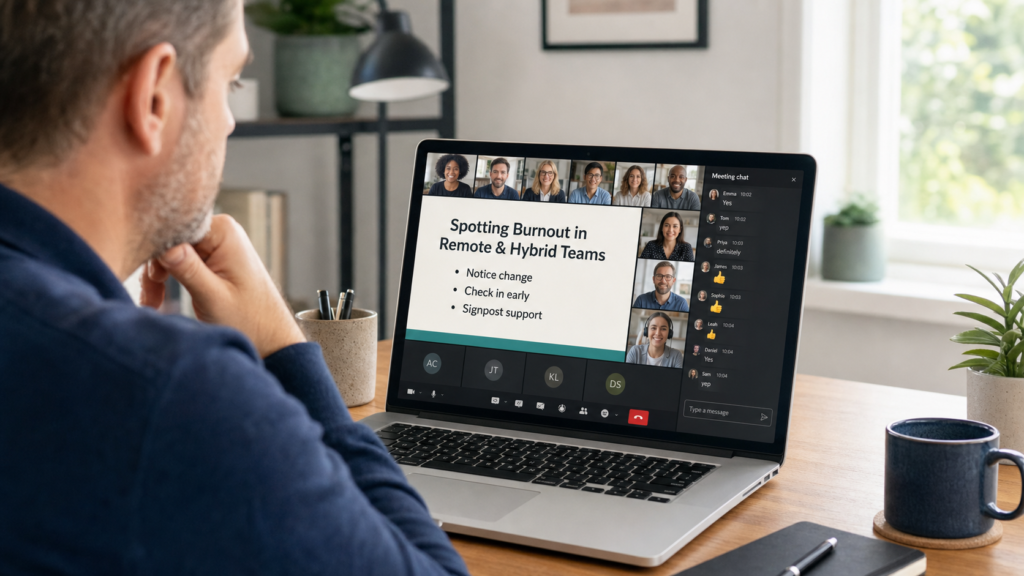
In one of my recent Mental Health Awareness for Managers workshops, I asked a simple question:
“Do you think it is more difficult to spot burnout, stress or signs of poor mental health when employees are working remotely or hybrid?”
The chat lit up straight away: yes, yep, definitely, and a flood of thumbs-up emojis.
And I agree.
During lockdown, when I was supporting private clients over Zoom, I noticed how different it felt. In those early days, the lighting was often poor, cameras were not always great, and people could not easily blur their backgrounds. At first, I found it harder to pick up on some of the signs I would normally notice in person.
After a few weeks, I realised why. In face-to-face work, I was used to noticing the whole person. Not just their words, but posture, movement, hands, energy, breathing, facial expressions and general presence. Online, we often only see someone from the shoulders upwards. Sometimes we do not see them at all.
That matters significantly.
A camera-off meeting does not automatically mean someone is struggling. But remote and hybrid working can reduce the number of cues available to managers, which means we may need to pay closer attention to smaller changes over time.
Mental Health UK’s Burnout Report 2025 found that many adults continue to experience high levels of pressure and stress. Behind every statistic is a person who may be trying very hard to look fine on the outside while feeling overwhelmed underneath.
What A Recent Managers’ Workshop Showed
One of the most requested workshops I deliver is Mental Health Awareness for Managers. It is a 90-minute online session designed to help managers feel more confident spotting signs of stress, burnout and poor mental health at work.
I ran one recently on MS Teams with around 12 managers. At the start, many had their cameras switched off.
People often ask me whether there is a difference between online and in-person delivery. The answer is yes, and it is significant. Online delivery requires a different level of awareness, energy and structure. Over time, I have learned some useful approaches and developed tools I use to increase engagement, encourage participation and help people feel more comfortable contributing.
Remote meetings can make it harder to read the room. In a face-to-face setting, a manager might notice someone’s energy, body language, expression or whether they seem withdrawn. Online, those signs can be hidden behind a black square, a short message or a busy calendar.
Interestingly, when we moved into a breakout room activity and came back together, several people switched their cameras on. Sometimes people need a smaller, safer space before they feel ready to engage.
During the workshop, we spent around 20 minutes focusing specifically on burnout. We looked at how managers can spot signs and symptoms, the challenges they face when people are remote or hybrid, where to signpost someone for support, and how to have that initial conversation.
The breakout room activity was based on a simple workplace scenario:
If a fellow manager noticed that someone in their team was not quite themselves and seemed to be showing signs of burnout, what would they say, how would they approach them, and what would they do if that person did not want help?
The responses were varied, which is exactly why these conversations matter. Many managers want to support their people, but they are not always sure what to say, what their role is, or where the boundaries are.
7 Warning Signs Of Remote Burnout Managers Can Look For
Remote burnout can show up in different ways, but often it is about noticing a change from someone’s usual pattern.
1. Shorter Or Slower Communication
A normally responsive employee may start replying much later, sending shorter messages, missing emails, or sounding unusually flat. This does not automatically mean burnout, but a change in communication is worth noticing.
2. Reduced Energy In Meetings
Someone who used to contribute ideas may start holding back. They may seem distracted, tired, withdrawn, or less engaged than usual. In remote and hybrid teams, this can be easy to miss because silence can look like busyness.
3. More Irritability Or Cynicism
Burnout can sometimes show up as frustration, impatience or a more negative tone. A usually calm person may seem sharper than normal, or someone who is usually positive may begin sounding cynical.
4. A Drop In Confidence Or Performance
Someone who was previously organised may begin missing deadlines, making more mistakes, or struggling to prioritise. Managers should be careful not to jump straight to performance management without first checking whether pressure, workload or stress may be part of the picture.
5. Always Being Available
In remote and hybrid teams, another warning sign can be always being available. Sending messages late at night, replying instantly to everything, working through breaks and never seeming to switch off can look like commitment. But sometimes it is a sign that someone is struggling to set boundaries.
6. Changes In Facial Expression, Tone Or Presence
Managers can pay attention to smaller online cues, including tone of voice, facial expressions, tiredness, tension, pauses, lack of usual humour, or a mismatch between what someone says and how they seem.
If it feels appropriate in a one-to-one conversation, you might gently ask someone to sit a little further back from the camera so you can see more than just their face. This should be done sensitively, never as a demand.
7. Saying “I’m Fine” When Behaviour Suggests Otherwise
Burnout is not always loud. Sometimes it looks like silence. Sometimes it looks like irritability. Sometimes it looks like someone saying “I’m fine” while everything about their behaviour suggests they are not.
The aim is not to analyse every gesture or become an expert in body language. Although my own background includes management, coaching and body language awareness, the most useful skill is often much simpler: noticing when something feels different, then being curious and kind enough to ask.
How Managers Can Start A Supportive Conversation
Managers do not need to diagnose remote burnout or poor mental health. That is not their role.
Their role is to notice changes, open up a safe conversation and know where to signpost someone if extra support is needed.
A helpful starting point might be:
“I’ve noticed you seem under a lot of pressure lately. How are things feeling for you at the moment?”
Or:
“I’m not asking you to share anything you don’t want to, but I wanted to check whether anything is making work harder right now.”
Or:
“Would it help if we looked at priorities, deadlines or meeting load together?”
These conversations do not have to be perfect. They need to be human, respectful and calm.
Managers should avoid jumping to conclusions, forcing someone to disclose personal information, or turning the conversation into a performance issue too quickly. Sometimes the most helpful thing a manager can do is listen properly, reflect back what they have noticed, and ask what support would be useful.
What If Someone Does Not Want Help?
This is one of the situations managers often worry about.
What if you notice signs of remote burnout, open up a conversation, and the person says they are fine or does not want any support?
In that situation, it is important not to push, diagnose or force disclosure. You can keep the door open, remind them what support is available, agree to check in again, and continue to monitor any work-related concerns.
You might say:
“That’s okay. I just wanted to check in because I’ve noticed a few changes. You don’t have to talk about anything today, but the door is open if that would help.”
You can also signpost to internal support such as HR, an Employee Assistance Programme, Occupational Health, Mental Health First Aiders, or external professional support where appropriate.
The key is to stay supportive while also keeping clear boundaries. Managers are not therapists, but they do have an important role in noticing when someone may be struggling and helping them access the right support.
Building Manager Confidence Around Remote Burnout
Thinking back 10 or more years to my own time in management, it is striking how much managers were expected to deal with, often with very little practical support. We might have had external consultants come in, usually in a shirt and tie, to talk about communication or mental health. And yes, there was often role play.
For many people, the words “role play” are enough to make them break out in a cold sweat.
These days, I prefer to give people options. Some managers are comfortable practising a conversation. Others would rather talk through a case study and discuss what they might say. The important thing is not to force people into performing. It is to help them build confidence so that when a real conversation comes up, they feel more prepared.
Remote and hybrid working are here to stay for many organisations. That means managers need practical tools for noticing when someone may be struggling, even when the signs are less visible.
Spotting remote burnout is not about getting it right every time. It is about noticing change, asking early, listening properly and knowing where to signpost.
If remote or hybrid working is affecting your team’s wellbeing, our Working From Home Stress & Burnout Support can help.
I also deliver workplace mental health talks and manager awareness sessions for organisations that want to build confidence around these conversations.
To discuss support for your team, please get in touch.
About Mike Lawrence
Mike Lawrence is a Health and Wellbeing Consultant, Mental Health First Aid England Instructor, and workplace mental health speaker.
He works with organisations across the UK to strengthen wellbeing, resilience, and performance through practical, real-world approaches that stand up under pressure.
His work focuses on:
- supporting leaders and managers to respond confidently to mental health challenges
- delivering Mental Health First Aid training that translates into real workplace impact
- helping organisations move beyond awareness into meaningful cultural change
Explore more: